Showing posts with label art gallery. Show all posts

Thursday, September 13, 2012

The Cultural Landscape Architects: Hudson of Feature Inc.

In lieu of the standard headshot for Hudson, Feature Inc. sent various portraits that artists have made over the years; this 'upside-down' portrait is by Judy Linn, whose work is currently on display 'upfront' at Feature Inc.

As the owner of the highly-respected art gallery Feature Inc. for 27 years, Hudson has exhibited art uncompromisingly based on aesthetic -- not business -- principles, as well as the values of pluralism and diversity shaped during his years as an artist and non-profit arts administrator. Feature, which began in Chicago, moved to NYC's Soho, then Chelsea, and now located on the Lower East Side, launched the successful careers of Raymond Pettibon, Jeff Koons, Takashi Murakami, Richard Prince, Charles Ray, Tom Friedman, and many others. Yet throughout Feature's history, Hudson has exhibited and supported art/artists without regard to economic considerations or the artists' positions within the critical art establishment. He continues to exhibit some of the most incredible and interesting art in New York City today, and his gallery is a favorite among artists as well as critics and smart collectors.
 
All images courtesy of Feature Inc., Hudson and the artists.

(A version of this interview appeared on the Huffington Post in September of 2012.)


Julie Chae: How did you decide you wanted to open your own gallery?
 
Hudson: In mid-1983 I decided to leave the not-for-profit sector, the artists-run spaces, and open a commercial gallery (on April Fool's Day, 1984). I used a few thousand dollars from a grant that I had received for my work as an individual artist and a $ 5,000 loan from my father to open the gallery.

For the two or so years prior I had been increasingly dissatisfied with the watered-down results of the peer-panel decision process that was then, for that field, the structure by which curatorial decisions were made, and wanted to find a way out of that. I was more interested in the way autonomy allowed me a greater range of possibilities, wider extremes, swifter decisions, and a more expansive thinking. A gallery seemed the way to go.

This photo of Hudson with Tom Friedman's sculpture is by Judy Linn

JC: Your consistently strong vision for groundbreaking art amazes everyone. What has shaped your artistic sensibilities and helped determine the kind of art you want to share with the public?

Hudson: Certainly my largest influence is derived from my experience of being an artist who is content-oriented -- making work more meaningful by working from the personal -- and having an interest in and respect for skill and technique. But I also am deeply indebted to my experiences in the not-for-profit sector, where the commitment is to art and artists and not economics or trends.

JC: Getting more specific, what makes you choose to display one artist's work and not another's?

Hudson: There are a number of factors, some personal and some social, things like:
that the artist has been developing their skills and ideas for more than five or so years, seems committed to their investigation, and while there is a solid sense of form and resolve in the work it also displays the possibility to develop/change; that there be a sense of adventure, care, intelligence (but not overly so), investigation, and intuition in the artist and their work; my excitement about the work and how its meaningfulness interfaces with my perception of what is going on in the art world and the culture at large; wanting to encourage the artist to continue to grow and expand and bring more of what they are doing into the world; that there is a personal uniqueness in what they are doing...

This bubblegum drawing of Hudson is by Jim Shaw

JC: So how much of your decision is influenced by factors related to the artist versus the artwork? In other words, how much, if at all, does it matter to you that an artist makes great work AND not be a pain in the ass?

Hudson: Art first, artist next, gallery third, me fourth. Yet if an artist is a big pain in the ass, I will pass on working with them and their work.

JC: As you know, I'm friends with Douglas Melini who recently had a solo show at Feature Inc. this past July/August and received a terrific NYTimes review (Roberta Smith). So for example, could you describe how you decided to exhibit Doug's work? 

Douglas Melini: A Sharing of Color and Being Part of It (10 July - 11 August 2012) at Feature Inc.
 
Hudson: I've been watching Doug Melini's paintings for about ten years, since I saw his exhibition at White Columns in 2003.

His paintings have always been catching my eye, but in terms of representing artists, I am generally hesitant with the more formal types of abstraction as, soon after the initial inventiveness is established, far too often it slips into a kind of arrested development. Its horizontal expansion becomes predictably incremental and there is almost no vertical expansion. Frequently this type of art becomes fussy and insular, two qualities that I prefer less of. I wanted to be fairly certain that this would not happen with his work.


 Douglas Melini, Colossus, acrylic on canvas, overall dimensions 8 ft x 63 ft (2000-2003), white room installation views at White Columns in 2003; courtesy of the artist

 JC: And what happened as you were watching Doug's work over the years?

Hudson: Two or three years ago, when he added his hand-painted frames to the paintings, and 'the painting' thoughtfully moved into new territory, from paintings to painted objects, I could sense that his thinking, inspiration, and intuition were quite secure. Then it was just a matter of scheduling.

Douglas Melini, The Forms of Thought, acrylic paint on canvas with hand-painted frame; 71.5 x 45.5 x 1.75" (2010)


detail of hand-painted frame, right side edge 
 
JC: How did you decide to schedule his show? Were you thinking in terms of other exhibitions and your programming?

Hudson: It was in fall of 2011 that I began to think that he should be the summer 2012 exhibition at Feature. That is a time I traditionally use for a group exhibition, but I thought what he was doing was important/engaging/developed to warrant a one-person exhibition. In terms of programming continuity, I'm not a strategic planner. My opinion is that you just butt good things up against one another and let them do the work.

JC: Do you have a certain way of describing an artist's work to say, collectors, or others who might inquire?

Hudson: When someone asks me about any artist's work, I address what the artwork means to me, my excitement and interest in the physical nature of the work and its surrounding ideas and that work's relationship to this time we live in.

JC: What about the artist's background? 

Hudson: I generally don't speak much about the artist's exhibitions history, collection inclusions, or cite their education. None of that stuff has anything to do with the successfulness of the work. And when one is appreciating and purchasing art, especially with younger and mid-career artists, it is the art and not the social position or investment that is important and meaningful.

JC: I don't know how you keep finding such incredible artists; one of my very favorites at Feature is David Shaw. I have just decided to accept that I love everything he does. Can you explain why his work is so appealing?

David Shaw, Lee, wood, glass, 41 x 38 x 51 inches (2009)
 
Hudson: The nature/science discussion in David Shaw's work is particularly timely, wide and loose, and is enhanced by the work's engaging materiality. Some aspects of the work are quite literal, some physical, some are poetic, and yet some others link to you via intuition, intellect, or playfulness. This complexity allows viewers to enter his works from a variety of hallways that are all relatively friendly and open.

 David Shaw, Dark Materials, 2011; wood, steel, holographic laminate, paint, epoxy, flocking; 31 x 22 x 13.5”

JC: How did you start working with David and what is it like working with him?

Hudson: He introduced his work to the gallery via the quintessential packet of images/info very soon after the gallery's 1988 move to NYC. Working with him continues to bring me a wide range of information, images, and ideas that enhance my understanding and appreciation of his work and, as well amuse my day-to-day. The guy is rigorous, decisive, comprehensive in his thinking, has a terrific sense of humor, and is relatively fearless.

JC: I also love the drawings on (pink!) paper by Kinke Kooi. It's a purely visceral reaction; they are amazing. You've worked with her for a while now -- what makes her work so wonderful?

Kinke Kooi, Female View, acrylic paint, graphite on paper; 36.75 x 26 inches (2010)
 
Hudson: The primary grabs of Kinke Kooi's works on paper are the slowly drawn repetitive graphite lines lying on top of the individually hand-coloured pink paper, the way the depicted scenes dive deep into increasing detail, how her rendered representation smoothly moves in and out of areas of abstraction, the playful push and pull between foreground and background, and the way big ideas and little ideas sit comfortably together.
 Kinke Kooi, Everything Is Vain, 2011; acrylic paint, marker, graphite on paper; 30.25 x 22.375 inches
 
JC: Looking back on all this time you've been running your gallery and looking forward as well, what are your ultimate hopes and goals for yourself and for Feature Inc.?

Hudson: So I've had the gallery for 27 years and, it seems that throughout the years, the driving force has remained the same: to exhibit and share my excitement for what and how artists do what they do. I really don't have other goals; its been a slowly evolving situation. When I look back at Feature Inc.'s history the essence is the interaction of art and people. It's been an inspiring education.

This graphite portrait drawing of Hudson is by Michael St. John


Judy Linn, Bud, 2012; digital inkjet print; 22 x 16.5 inches; ed. 1/7; currently on view at Feature Inc.


 Josh Podoll, A Color that Does Not Exist, 2012; acrylic paint, oil paint on canvas; 24 x 18 inches; 
in "Josh Podoll: paintings," currently on view at Feature Inc.
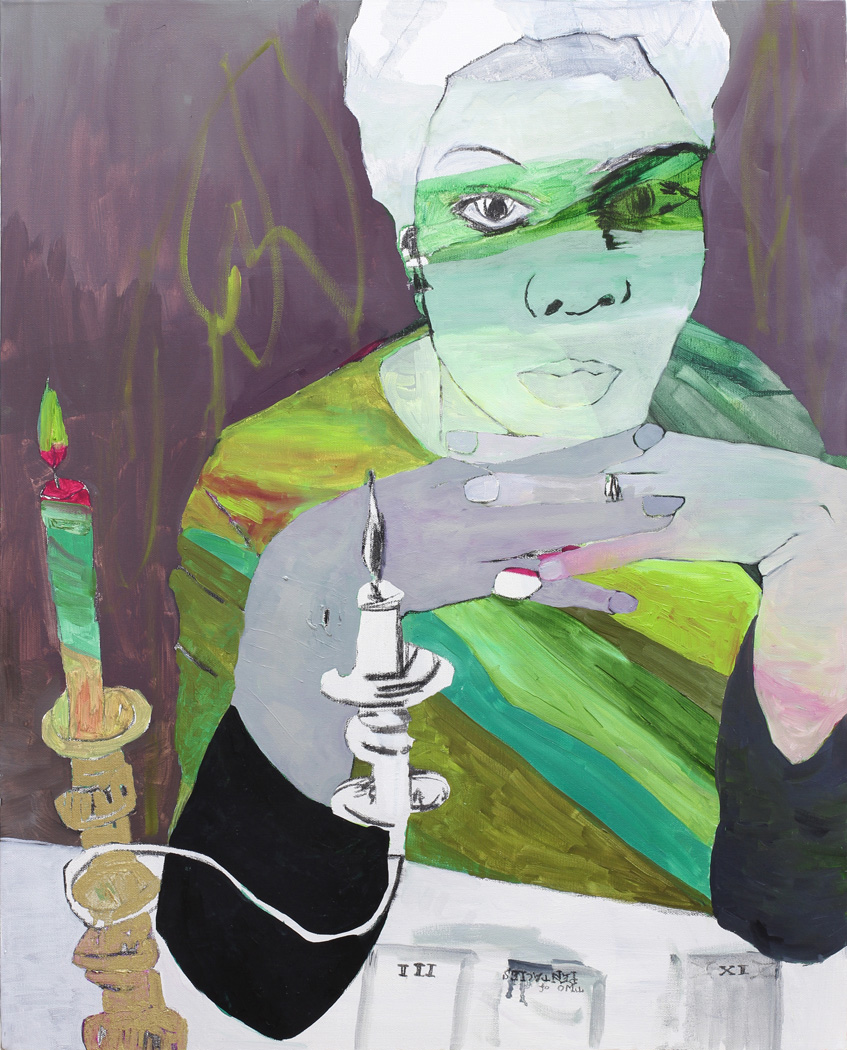

 
Gina Magid, Le lecteur de tarot (Nina Simone), oil paint, charcoal on canvas, 30x24" (2012); 
in "Gina Magid: paintings," currently on view at Feature Inc.

Current exhibitions on view: September 5 - October 7, 2012; for more information, see: http://featureinc.com/.  

 David Shaw's Dark Materials (2011), wood, steel, holographic laminate, paint, epoxy, flocking, 31 x 22 x 13.5" (l) and Doug Melini's Invisible Change (2012), acrylic paint on canvas with hand-painted frame, 23.5 x 19.5 x 1.75" (r)

David Shaw describes the moment of inspiration that resulted in this photo: 
This image came about when I stopped by Feature to decide on pedestal sizes for Dark Materials because Hudson was showing it in the Nada Art Fair in Hudson, NY. It was a few days before Doug's opening and his incredible exhibition was already installed. (I have been a fan since before Hudson was showing him and asked Hudson to take another look at his work back in the day.) We pulled out the box pictured so as to have a visual take on the height and so forth, then Hudson got a phone call. I quickly moved the box and sculpture into the exhibition space and snapped this pic for Doug. The formal relationship was undeniable even at a distance, but setting it up this way highlighted the fractured chemical underpinnings of each piece. Doug's painting Invisible Change became a schematic, an origin, a synaptic plan for Dark Materials and, when I think about it, vice versa...
 -- David Shaw, September 2012


Wednesday, February 29, 2012

The Cultural Landscape Architects: Scott Zieher of ZieherSmith

(An abbreviated version of this interview appeared in the Huffington Post in February of 2012). 


"Liz Markus: The Look of Love," February 16 – March 17, 2012, at ZieherSmith

As New York began to rebuild from September 11, 2001 and move into the 21st century, a new wave of younger people became successful art dealers. Scott Zieher and Andrea Smith (now, Andrea Zieher) opened ZieherSmith in 2003 and helped lead the way, with Andrea serving as President of the influential New Art Dealers Alliance (“NADA”) from 2005 to 2009. In addition to his “day job” as a prominent gallerist, Scott is an accomplished poet with three brand new books that just released this month.

All Photos Courtesy of ZieherSmith.


Scott Zieher (Photo: Andre Pretorius)

Julie Chae: Scott, how did you and Andrea decide to start your own gallery?

Scott Zieher: I had been working in midtown selling contemporary art for 2 years, in the spring of 2002, and my (now) wife Andrea was working as a director of exhibitions uptown for an American paintings dealer, Vance Jordan. We were living in Spanish Harlem and seeing shows constantly, writing $25 online reviews for AOL’s Digital City. We were both more interested in emerging, younger artists, and I knew a lot of great, unrepresented people that we felt would continue making strong work and likely sell. I started doing shows in my apartment and this unrepresented work was selling, so we felt confident we’d garner broader appeal with a storefront space.

September 11th happened and really changed everything; we decided to go after our own vision. We started looking for ground floor, store front space and after a few, excruciating months of hunting landed on a ground floor spot on West 25th Street. We were in business pretty quickly thereafter, opening on the Ides of March 2003. America went to war that day, so it seemed an auspicious start.

My memories of the beginning are very fond. My mother had passed away a couple of years earlier and I knew that she was proud of what we’d done.

JC: Were there any art world role models to guide or inspire you?

SC: My models are vast and various, but I can’t say anyone has influenced my eye, that’s far too personal. My mother gave me the freedom to be creative, and then encouraged it greatly when I seemed to gravitate toward the arts; I’m blessed for having her.

When it really comes down to it my influential precursors are specific to poets who’ve gravitated to the plastic arts and artists who’ve orbited poetry: principal, though are poets who championed art. I’ve most admired Frank O’Hara and Ezra Pound. O’Hara is well documented as a hero in the art world. His poetry has been invaluable: optimistic, urban, sophisticated and breezy, he danced with relative ease between the best of his contemporaries as a poet. Without caring much about academic aplomb, he forged careers for multiple canonical visual artists by way of a sociable, ambitious understanding of his American moment. Pound, despite his embarrassing political derivations, worked most of his life in the service of other poets and artists, this ceaseless approach is a model I strive for, and his output is unrivalled, multifarious and influential beyond comparison or recognition. His letters alone would dwarf the output of any artist you can name.

JC: ZieherSmith will be celebrating its ninth anniversary next month. Do you have any particularly special memories involving your shows or artists?

SC: Every show has a good story, if it matters in any way. I try not to dwell too much on shows past. I’m fond of our recent (December 2011) Allison Schulnik show “Mound.” We got great press and sold the work well and Allison is a complete joy to work with, across the board. After the opening we had dinner and she managed to get me to sing karaoke in Chinatown, a duet of Peaches and Herb’s “Reunited,” no less, and she’s a real pro!

Allison Schulnik, Standing Gin #3, 2011, glazed porcelain ceramic, 19”x12”x9”

SZ: I’m also proud to have shown an extensive selection of works by Joseph Cornell for his 100th birthday in December 2004, grouped with a great crop of young artists. Cornell is another model for me, both in his singularity and his broad knowledge.

Chuck Webster, Untitled, 2012, oil on panel, 48”x60”

SZ: I’ll always cherish the first studio visit with Chuck Webster: 2003, North Adams, Massachusetts, cold as hell, the best first meeting ever, warmed by Chuck’s huge blanket of drawings. Chuck is both utterly contemporary and steeped in a past that is riveting and relevant; he’s a great inheritor and rejuvenator of the constantly moribund tradition of abstract painting. 

JC: During Andrea’s Presidency, NADA became a powerful presence in emerging art and most agree that under her leadership, the NADA Fair became second only to the main fair in prestige and importance at Miami Art Basel. Could you or Andrea share a couple of her proudest achievements while she was heading up NADA?

Andrea Zieher:  NADA was a very grassroots thing that took off incredibly fast with the great vision of its founders. I was proud to take the helm and turn it into a fully-functioning, stable organization with a large annual budget. My changes included expanding to a full-time staff with medical benefits, an independent office, and obtaining federal legal status as a non-profit 501c6. In addition, my board members and I strived to maintain a focus beyond the popular satellite fair during Miami Basel and kept an emphasis throughout the year on the membership and public service. The international membership expanded greatly during my tenure and I made sure that membership dues were used solely for membership activities that enhanced business practices, ethics, and relationships.

SZ: Andrea worked really, really hard as president, and cared very deeply about the organization.

JC: Can you describe your program of artists or describe specific, special qualities about the art your gallery exhibits?  Would you articulate why it is important to exhibit the artists you do? 

SZ: We like to think our program consists of artists making technically sound and conceptually grounded work. I’m drawn to the narrative possibilities, and the human, hand-made.  Both Andrea and I, and most of our artists, are concerned with the past, and often this borders on a healthy obsession for me.

We also both really like old paper. I’m a sucker for the disembodied head and any smart re-interpretation of the human figure. I’m pretty visceral. That said, we try really hard to balance juicy, colorful oil painting with something that looks askance at the capabilities of a pristine white box.

I try really hard not to get caught up in what’s important about the things I do as a dealer, or discussing the idea of importance regarding art. I truly care about the people we represent and the work they make, and that’s what’s important to me. I’m trying everything I can to make sure their work lives on forever in as many capacities as possible.

JC: On a related note, I'd like to follow up on your comment in a May 2005 interview, where you say, “(A)s an art dealer, I like to think the ‘product’ we sell is pretty poetic.” 
When I read that, I completely connected with what you are saying, and it made perfect sense to me as I visualized the artists’ works that I know in the ZieherSmith program. Would you articulate what you mean by calling an artwork “poetic?”  

SZ: As a poet, I suppose I should be careful.  I mean that literally, in a kind of dictionary definition: I care about art that is emotionally charged and aesthetically relevant, but still challenging. Something poetic to me is a thing that has sensitivity above and beyond its bare facts. And to sell this type of “product” well, something which is a true luxury good as well as being widely misunderstood or ignored when it comes right down to it, takes the same resolve it takes to care deeply for poetry!

JC: Liz Markus and Eddie Martinez are acclaimed artists, good friends and popular among artists I know in New York. Liz just opened her 4th solo show at ZieherSmith!

How did you start working with them?

Eddie Martinez, Snake Eye, 2005, acrylic, pencil on paper, 11.5”x9”

SZ: We first showed Eddie in late 2005, at the NADA fair in Miami. He was introduced to me by Wes Lang at a party in Miami the year before (Eddie was making great, super-fast, little drawings on the beer splattered table, Wes was the DJ; that night will always remain as a swansong of December in Miami). Back in New York Eddie came to visit the gallery and we saw a lot of each other that Spring of 2005. His incredible energy and imagination were infectious. We had our first solo with him shortly thereafter and the rest is very successful history.

Eddie, in a generous turn, introduced us to Liz, including her in one of his many curatorial efforts.
Liz Markus, I Say a Little Prayer for You, 2012, acrylic on unprimed canvas, 54”x60”

JC: I remember that group show that Eddie curated; it included Katherine Bernhardt (KB), Jose Lerma and Andrew Guenther, as well as Liz. That was 2007 and the afterparty was at a dive bar in Chelsea and you’d ordered like a hundred pizzas to be delivered. KB introduced me to Andrew, who was painting those "dark" paintings back then, but I found him to be totally nice and not at all scary. And then there was a second afterparty in Eddie’s studio building in Bushwick, which back then was considered a really dangerous neighborhood. I'd never been there before so I didn't know. But Brian Belott got Eddie to call a car service for me when I was leaving. That cracks me up because you can still find multiple videos on the internet of Brian setting a huge fire to the hair on his head but that night he was concerned for my safety as I was leaving Eddie's studio building.

And what has it been like, working with Liz and Eddie?

SZ: Both relationships are nothing but fruitful, ambitious and reciprocal. We really try to embrace as much as we can of each artist’s approach to their practice, hopefully giving space when it’s needed and offering whatever we can when it’s asked for. We knew almost instantly with both artists that we’ve come upon something special. That’s all you can ask for, really; to recognize the ones with great focus coupled with ambition, and to recognize staying power combined hopefully with loyalty.

JC: I was visiting Liz’ studio back in 2007 and she showed me the press release to her first ZieherSmith solo show. I was very impressed with how you'd captured the essence of her work in a really nice way, and I asked her how it had been written. According to Liz, you two just sat down and talked about her work, and then you seemed to put it all together. Can you talk about how you approach discussing or writing about an artist's body of work (for an exhibition, let's say) and framing the way people look at that art?

Liz Markus, "All of These Things Were Way Beyond My Mind,” 2007, acrylic on unprimed canvas, 54”x72” 

SZ: I’m always delighted and shocked when people pay attention to our press releases, they can be the only public chance we have of “framing” the works we’re showing, and we try to take them seriously. Andrea is a very good, accomplished writer and a really keen editor and I guess it’s second nature to me to write about art, as I’ve actually been doing it for 30 years! I was really lucky to have art history classes in my high school in Waukesha, Wisconsin, so my ekphrastic impulse is long practiced.

Andrea typically lets me start and I improvise and gesticulate wildly for 3 paragraphs which she in turn carves into little ribbons of butter. It means a lot to me that people read our little 350 word expository exercises, so thank you.

JC: I so wanted to drive to Nashville for the opening of your pop-up space during the summer! I’d gone so far as to look up the driving route from NYC and asked Liz if she could go, in the hopes we might roadtrip. Since I saw it was a fifteen-hour drive, I’d emailed you to say that while 2 guys transporting art typically will drive non-stop for 20 hours, I suggested an overnight stop so you guys wouldn’t arrive exhausted -– maybe a stop in Charlottesville, VA, as the “grounds” (campus) are nice to walk around. You immediately emailed me back a detailed, 5-day itinerary that included a minor league baseball game! It sounded so great! 

So how much fun did you have driving down, with the excellent itinerary you’d planned? And why did you decide to exhibit in Nashville, when you could have been vacationing?

ZS: I was lucky to be driven to Nashville, with our dog, Robert, by a great ally and friend, Brad Hajzak. He’s a collector, advisor and great friend who wanted to be a part of the behind the scenes set-up for a travelling exhibition, so we made a road trip out of it. We mapped the route through Pennsylvania to stop at Falling Water and then Pittsburgh for the Warhol Museum. I managed to find us the worst hotel in Columbus, Ohio; even the dog was skittish. The next morning we proceeded to a marvelous chili dog lunch at Skyline in Louisville. We made good time and had a great trip.

We decided to do the pop-up because my wife’s family is primarily in the vicinity and we visit there often. There’s a lively scene in Nashville, and we hadn’t really tapped into it, so this seemed like a very thorough way to get to know some of the people making things happen. We were hoping to think apart from the art fair model, which has become really tiresome. It worked, as the local press all wrote at length about the show. We had a great turnout and hosted several events, we sold a good amount of work to local collectors who were new to us, and met a ton of artists, musicians and writers, including Dan Auerbach of the Black Key, who stopped by more than once.

JC: Have you decided yet whether you’ll do another pop-up show in Nashville this summer?

SZ: Yes we are! We have boots on the ground there, people looking at spaces for us all the time, but we can’t act on that until late Spring early summer.

JC: You’re a practicing poet. How do you find the dual energy to handle the needs and considerations and sensitivities of visual artists as a vocation while working toward furthering your own creative practice?

Scott’s latest books: THE PORNOGRAPHERS and PORNOGRAPHIES, with novelist Christopher Grimes (both: Jaded Ibis Press 2012); and GENTRY, featuring cover art by Stan Vanderbeek (Emergency Press 2012)

SZ: I love artists and the processes and practices of making art, I love art materials, in all their infinite capabilities. It seems perfectly logical to me to spend a life working in the service of people making art. Separating my own endeavors with the artists I represent has been crucial and very natural. As the age-old adage asks the poet: “what do you do with the other 23 hours in the day?” In addition to selling art, I write every day, and I have a desk at home where I work on collages. I’ll be in a group exhibition this summer at Charles Bank Gallery on the Bowery and I’m honored to be publishing three books this year, two are collaborations with Christopher Grimes: THE PORNOGRAPHERS and PORNOGRAPHIES (both: Jaded Ibis, 2012) featuring 195 collages I made in the last year. The other is my third book-length poem GENTRY (Emergency Press, 2012).

It’s my firm opinion that a poet who isn’t constantly writing poems, whole books of poems, or a poet who needs a pristine cabin in the woods with no distractions to create is a lazy poser. Quit sniveling, get to work. No excuses. If you truly care you will fail until you succeed.

Elbert Hubbard is one of my models. He wrote “Get your happiness out of your work or you will never know what happiness is.” Stellar advice; the world would be better off it was followed to the letter.
Scott Zieher, (Untitled), 2011, collage, from THE PORNOGRAPHERS, with Christopher Grimes (Jaded Ibis 2012)

Scott Zieher is co-owner of the contemporary art gallery ZieherSmith. In 2004 he won Emergency Press’ international book contest for his book-length poem, VIRGA. He has since published the following books: IMPATIENCE (Emergency Press 2009); BAND OF BIKERS (powerHouse Books 2010), his collection of found photographs from 1972; GENTRY (Emergency Press 2012), his third book-length poem; and THE PORNOGRAPHERS and PORNOGRAPHIES (both: Jaded Ibis Press 2012), collaborations with novelist Christopher Grimes featuring Zieher’s collages. Recent poetry has appeared in The Believer, Jubilat, KNOCK and The Iowa Review. Zieher was born in Waukesha, Wisconsin and received his MFA in poetry from Columbia University in 1996. He lives in Manhattan with his wife (and co-owner of the gallery) Andrea, their son, Tennessee and dog, Robert.
516 West 20th Street
212-229-1088
Currently on view: "Liz Markus: The Look of Love," February 16 - March 17
Upcoming:" Paul Housley: Mudpusher Blues," March 22 - April 21


Tuesday, November 1, 2011

Interview with Camilo Alvarez of Samsøn

(An abbreviated version of this interview appeared in the Huffington Post in November of 2011).  


Mark Cooper:  More is More, on view at Samsøn, October 21 – December 10, 2011 (Photo:  Clements|Howcroft)

Many who love art and enjoy experiencing it at museums, galleries and non-profit art spaces have little idea that those experiences would not be possible without the efforts and contributions of curators, gallerists, art installers and others working behind the scenes. 

This post is the first in a series I am informally calling "The Cultural Landscape Architects." They are art world professionals who play a role in connecting art with the public. They decide which artworks by which artists are presented, place the art in the contexts of both art history and current times, and help shape the cultural landscape. 

I met Camilo Alvarez, the owner of the critically acclaimed and beloved art gallery Samsøn, because all my artist and gallerist friends in New York told me it was the place to see in Boston during my time there in 2007-2008. A friendly, "hip-but-unpretentious" fellow with serious smarts, Camilo traverses many worlds. In recent years at Art Basel Miami Beach, I have run into him at places as wildly different as the fancy rooftop bar where he was entertaining ICA/Boston board members and the crazy karaoke dive bar in the basement of the Shelborne. Equally adept at working with artists and collectors, he exhibits art that is challenging, serious and provocative.

Camilo Alvarez (r), during "Chain Letter" at his gallery, Samsøn (Photo:  Justin Freed)

Julie Chae:  Hi Camilo, when did you decide to open a gallery?

Camilo Alvarez:  I can't recall the exact moment I decided to open a gallery, but I do remember when I decided I wanted to work with art.  I was on a high school (Walton in the Bronx) trip to the "Basquiat" show at the Whitney and I remember seeing how activated my classmates were.

JC:  Bronx schoolkids on a field trip to a Madison Avenue art museum! And what was going on?

CA:  These were rough and tough kids from the streets and "third" world countries, awestruck by what they saw and amazed by the maker.  Spontaneous conversations among timid teens, hard thugs and well-heeled strangers?!  I knew I wanted to help perpetuate more reactions and situations like that.

JC:  Is this why you decided to go to Skidmore?

CA:  Yes, Skidmore had a great library and an ambitious art program.  I studied Art and Art History there.  I knew I wanted to get as much behind-the-scenes action as possible. 

JC:  And what other kinds of experiences have influenced your thinking about art and what you want to do in the art world?

CA:  After college, I went back home to work for artists, galleries, art delivery companies, museums, including Exit Art and Socrates Sculpture Park, among other places.  One of my favorite jobs, or positions rather, was at an artist residency, the Skowhegan School of Painting & Sculpture.   At Skowhegan, I was the Program Associate, which meant I was in the NYC offices most of the year and then at the actual residency and studios in Skowhegan, Maine, for 9 weeks in the summer.  It's magic up there.  Besides the history of the place, it's also at the forefront of contemporary art because its Board of Governors is made up of all accomplished artists.  They provide a strong stewardship. I'm currently going for a Masters.  Museum Studies.  Harvard.  Yes.  All these faces and places have most assuredly infected my understanding of art as an experimental social expression. 

JC:  You get a lot of respect from art world peers for your gallery's bold and original program. Would you describe your vision for the art you're interested in showing at Samsøn?

CA:  The program, hmmm everyone from the "art world" asks that.  The viewer doesn't care about "the program"!?  I think it, "the program," is constantly evolving as everything should.  I would describe it as diverse, be it medium, gender, background, ideas...kinda like the viewer.  I go for what I would loosely describe as the "transgressive accessible."  Showing work that discomforts, work that can relate to people outside and inside of "the art world," because it is a strange place to be.  Some Machiavelli for you:  "[T]here is nothing more difficult to take in hand, more perilous to conduct, or more uncertain in its success, than to take the lead in introducing a new order of things...."  In a commercial gallery, a single exhibition can deter a lot of future sales or incite a slew of people calling the gallery to get removed from the email list.  In the grand scheme of things then, it makes you wonder if "the program" matters. 

JC:  Well, you definitely do not shy away from exhibiting art that could be construed as “controversial.” Your second show with Gabriel Martinez is even more intense than the first one you had.

Gabriel Martinez, September 9 – October 15, 2011, Installation View, Samsøn (Photo: Clements|Howcroft)

JC:  And so despite owning a commercial enterprise, you continue to show art that is difficult, can confuse and can upset people. Last spring, you exhibited a solo show of work by the fantastic Hank Willis Thomas, whose past solo shows have had titles like “Branded” and “Pitch Blackness.” How did people react to this show?

CA:  It was revealing to show Hank, an African-American artist who predominantly deals with the depiction of color in advertising, in very white Boston.  The younger generation, the students, grooved with it and were completely familiar with the racial tropes, whereas others were leery of it.  That space in between is where the magic happens – a slight discomfort. The viewer wonders if they're missing something or if they can believe what they see. 

Hank WIllis Thomas, Scouring the Earth for my Affinity, Installation View, Samsøn (Photo:  Clements|Howcroft)

JC:  I was impressed with the Thomas exhibition and equally thrilled to get your announcement about Samsøn’s participation at zonaMACO with works by Victoria Fu, Carrie Mae Weems, Francesca Woodman, Alix Pearlstein, Summer Wheat and Adrian Piper.  These are not artists that regularly get seen in a lot of commercial galleries outside of New York and LA in the U.S.; I hope you get a chance to exhibit their works in Boston, as you did with Thomas.

CA:  Yes, I curated the booth at zonaMACO in Mexico City this year.  Exhibiting abroad is always intense; from dealing with customs and shipping to making sure you pace yourself for a long week.  It’s a gambit that can be edgy and economically smart.  Most of the works were photographs or videos, so multiply available, but then I don't represent most of those artists so there is always a chance people will go elsewhere for the work.  I enjoy mixing generations; seminal artists like Adrian Piper and Carrie Mae Weems along with emerging artists Victoria Fu, with whom I had never worked previously, and Summer Wheat, whom I just started showing.  
  
Summer Wheat, Bone Breaker, 2010, oil and acrylic on canvas, 16 x 20 inches

JC:  Mixing generations is a wonderful way to contextualize art. What’s a particularly special exhibition in which you were able to do this?

CA:  I recently exhibited the entire Woodman family:  Betty, Charlie, Francesca and George.  They had never shown together.  Betty is a sculptor, Charlie does video, film and performance, Francesca photographed and George has been painting on photographs recently.  George and Betty met in Boston and have been showing for decades!  Betty is one of the few living artists to have had a retrospective at the MET.  It was predictable some wanted to talk about Francesca's suicide, but most viewers noticed how the thread of family can run through the work.  The exhibition was installed so it was as if you were listening in on the family's conversation.  It’s a wholesome subject that is considered perhaps hokey, but this first social structure is necessary and incredibly important.

Betty, Charlie, George & Francesca, December 10 - February 26, 2011. Installation View, Samsøn 
(Photo:  Clements|Howcroft)

JC:  From an exhibition that addresses issues involving the fundamental human social structure to the summer event “Chain Letter,” which looks like it was a grand, fun, free-for-all. Can you say something about "Chain Letter," the event/exhibition, that you had in July this past summer?

CA:  Chain Letter was more of a community building exercise. The summer is usually dead for the art world, so this was a word-of-mouth experiment.  The real part of the “exhibition” happened with the moment you [the artist] received the letter of admiration and then forwarded it on. The 1200-plus objects that arrived at the gallery served as documentation of that interaction. 

Chain Letter exhibition/event at Samsøn (Photo:  Justin Freed)

 
Chain Letter exhibition opening, outside at Samsøn (Photo:  Nancy Fulton)

JC:  Because Samsøn serves as venues for projects like “Chain Letter,” curated video screenings and arts performances, your gallery has always been extremely popular with local artists who crave more exposure to cutting-edge art. Now you have found another way to support local artists – by providing a residency program that allows a chosen artist to work out of a studio beneath the gallery. Why did you decide to do this and how does it work?  

CA:  Ah yes and sübsamsøn, the residency.  I miss that direct interaction with the artist that I’d had when I worked at Skowhegan, which as you know is one of the premier US residencies.  The details:  the artist pays rent here.  I get them professional experience:  studio visits, exhibition opportunities, sales.  Pretty clearcut, kinda. They are artists based in New England, "local" artists with no representation.  I find them from looking around. We are basically in it together so I decide who gets in. 

JC:  Sounds like a good deal for the artist who needs to pay rent for his/her studio anyway, whether in a separate building or in a corner of the apartment, it’s a cost of making art, like materials and supplies. In return the artist gets constructive feedback from you, business/career/strategic advice, introductions to critics, curators, gallerists, collectors, a residency program to add to their resume, and a professional to take care of any sales?

CA:  And the $357 monthly rent is more of a token commercial relationship. Let’s not talk about the packages we send out for the resident artist, the exposure to “First Friday” crowds, the projects I get them. It’s all good.

JC:  Since it sounds like the residency application/acceptance is an informal process, do you want to share the story of how you met John C. Gonzalez, your current sübsamsøn artist? What did you see in him or his work that you thought was interesting or powerful or promising?

CA:  I first saw John's work in a Museum School (School of the Museum of Fine Arts, Boston) sale.  It was one of those funny/weird, army/lego-looking prints. And then I saw the name:  ‘Wow a Latino – sweet.’  I then re-met him at a project he and some other Museum School folks were doing in Dorchester called “Lufthansa.”  I did a communal studio visit with them.  Then I find out he's Puerto Rican and Irish?  Nice combo.  Then I find out he was in residency at Skowhegan.  Then I find out he did a residency in Wyoming where he came up with his own cattle-branding iron?  I think there's something about artists that can comment in many or any media on contemporary subject matter; it takes skill and bravery. 

John C. Gonzalez, Self Portrait (Anonymous mail-order painting artist hired to paint an image of him or herself) 2009

JC:  You're from NYC and you once told me you moved to Boston "for love," which is adorable, you know? Having met your wonderful wife, I have to agree it was a terrific decision. 

CA:  Yes, love is the answer!  Everyone should leave their hometown.  Unplug the umbilical. Alexandra, my wife, left her hometown of Boston for NYC and we left my hometown (NYC) for hers.  Eventually, we might have to find a new hometown for the both of us.

JC:  Well, I know people in Boston and in NYC that love both of you, so let’s discuss those places. New York is a magnet for the arts, but other communities have locals that love art too, including Boston. And you are constantly demonstrating you are committed to engaging in a serious dialogue about art and culture with the community there.

CA: I love NYC and I visit often, but it has changed.  It's not what it used to be.  I feel the worship of money is fraught with problems.  Opportunities that were once at the fingertip are now lost, misused or unavailable to most.  It’s like that everywhere, but it's just in your face and fast in NYC.

Boston is an interesting city.  Much more subtle and low-key, and it’s physically easier to leave than NYC.  There has been a historical rivalry between the two places, which is funny; there's no need for it.  There are a lot of students in Boston – young sponges ready to spring and spread upon the world.  I don't feel that to contribute to culture you have to be based in a place anymore.  NYC taught me that and Boston extended it for me.  

JC:  So, Camilo, care to make one last statement here of your own choosing about art?

CA:  Obscure and opaquely intellectual art for its own sake is highly problematic for me.  It seems people who need an inbuilt social situation to satisfy an existence is pathetic. Why such self referentiality?  I hate cliques.  I got into art because my curiosity and need for knowledge is insatiable.  Art for me encompasses everything.  We are a species ... not American, Thai, or New Yorker.  Fucking reflect, y'all!  If art is made and isn't seen, does it exist? 


Camilo Alvarez is the owner (and drector, curator and preparator) at Samsøn (founded as Samson Projects in 2004) in Boston, Massachusetts. Camilo was born in 1976 in New York City to Dominican parents and lived in Santo Domingo for 7 years. He received a BA from Skidmore College and is currently studying to receive a Masters in Museum Studies from Harvard University. He has worked at, among other places, Exit Art, Socrates Sculpture Park, the Whitney Museum of American Art, the Museum of Modern Art, MIT’s List Visual Art Center and the Skowhegan School of Painting & Sculpture. Samsøn’s programs and exhibitions have been reviewed by, among others, ArtForum, the Boston Globe and Flash Art. Gallery artist Gabriel Martinez just had his second solo show in September, and currently on view at the gallery is Mark Cooper (October 21 – December 10, 2011). See http://samsonprojects.com for more information.
--- 
An abbreviated version of this interview appeared on the Huffington Post in November of 2011.  This post is the first in a series by curator Julie Chae in which she provides commentary on the process of disseminating art to the people and profiles art world professionals involved in that process. You can find more at http://juliechaeprojects.com.